If you’ve ever hovered over the “Book now” button and thought, “…but how much is this going to hurt?” — you’re not being dramatic. You’re being sensible.
Tattoo pain is real. It’s also predictable in some ways (placement, session length, your body on the day) and totally unpredictable in others (your personal pain threshold, nerves, hormones, sleep, stress). Even reputable health sources emphasise that pain varies by placement, size/style, technique, and how you prepare.
At The Inkpot, we’re not into macho nonsense. You don’t get a medal for suffering in silence, and you don’t need to “prove” anything to deserve a tattoo you love. What we want is this: you walking in prepared, sitting well, leaving proud — and healing clean.
Let’s talk about what tattoo pain actually feels like, why some areas sting more than others, and how to handle it like you’ve done this a hundred times (even if it’s your first).
Tattoo pain isn’t a test
The first truth: pain tolerance isn’t personality. It’s nerves, biology, hydration, sleep, stress, and what you’ve eaten. Healthline notes that pain experiences differ person to person, and also depend on your physical health and how you prepare.
So if your mate “barely felt it,” that tells you exactly nothing about how it will feel for you. And if you’re nervous? Normal. Most people are.
What tattoo pain actually feels like
People describe tattoo pain in a few common ways:
- A hot scratch (like a continuous cat scratch)
- A sharp sting (often during lining)
- A burning/raw feeling (especially when shading goes over the same area)
- A weird vibration (when you’re close to bone)
It also changes as you go. The first few minutes can feel intense because your brain is zoomed in on the sensation. Then your nervous system settles and you find a rhythm. Later (especially in long sessions), fatigue kicks in and the same sensation can feel louder.
Why some placements hurt more
This part is fairly consistent. The places that tend to hurt more usually have one (or more) of these factors:
- More nerve endings
- Thinner skin
- Less padding / closer to bone
That’s exactly how medical-style guides explain it: tattoos are generally more painful where there are lots of nerve endings, thin skin, or bone with little fat between needle and nerve.
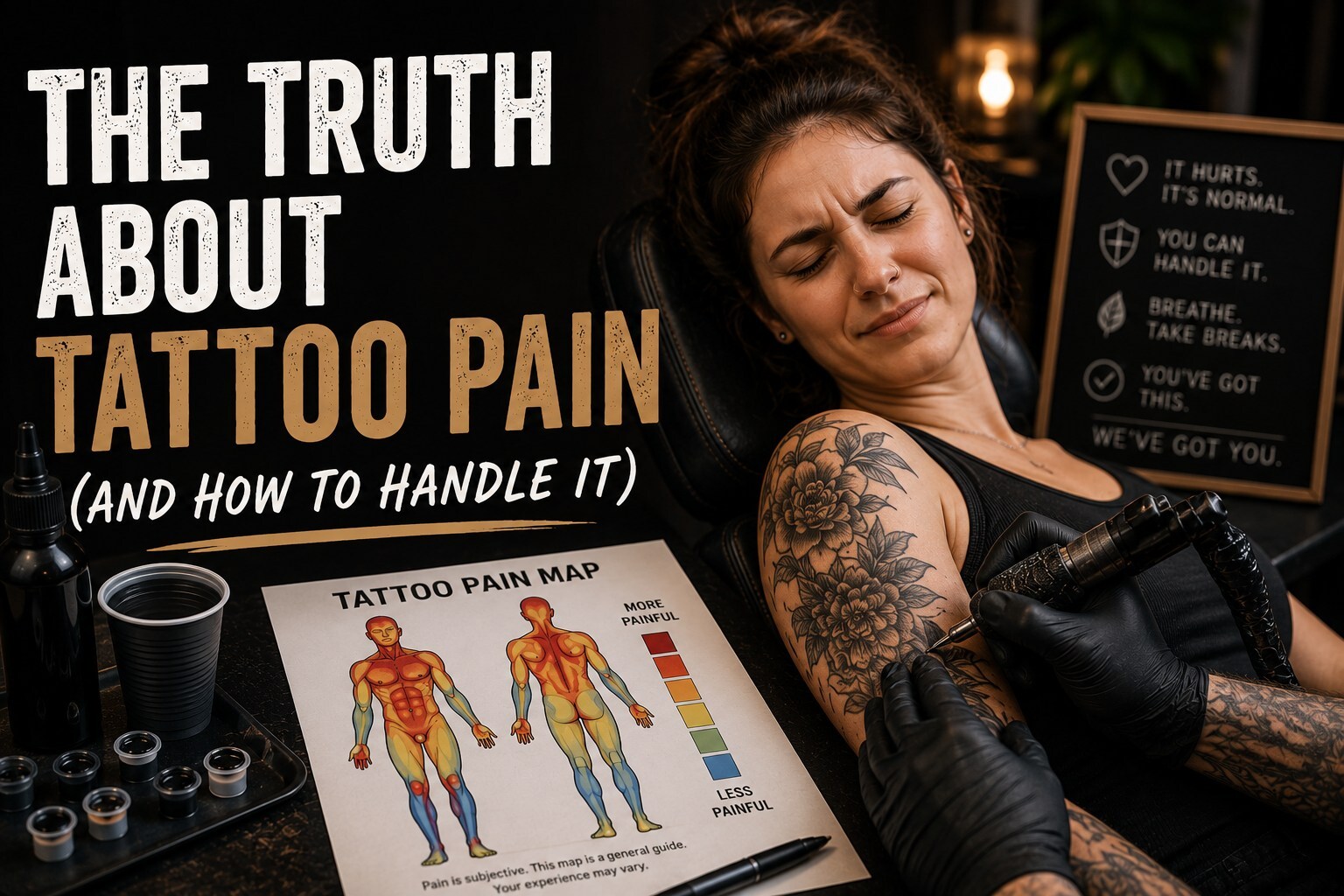
A simple “Inkpot” pain map (no ego edition)
This isn’t a promise, but it’s a useful starting point:
Often easier (good first-tattoo areas for many people):
- outer upper arm / shoulder
- outer forearm
- outer thigh
- upper back
Middle ground (you’ll feel it, but it’s usually manageable):
- calf
- front/side thigh
- lower back
- parts of the chest (away from sternum)
Spicier territory (common “okay, yep, this is real” zones):
- ribs / sternum (thin skin + bone + breathing movement)
- inner bicep
- elbow ditch / knee ditch (creases = sensitive + movement)
- shin / ankle / foot
- hands / fingers
- neck / spine
If you want a deeper dive on “most/least painful areas,” Healthline’s pain chart gives a widely referenced overview with the same core logic (thin skin, nerves, bone).
The part nobody tells you: pain changes during the session
Even if you’re absolutely fine at the start, many people find the last stretch harder. A long sit can get more intense because:
- your skin becomes irritated and sensitised
- your body gets tired
- your stress hormones fluctuate
- you start tensing without noticing
That’s why bigger pieces are often best done in planned sessions — not because you “can’t handle it,” but because it’s smart work and it protects the quality of the tattoo.
How to handle tattoo pain (before you arrive)
Most pain management happens before the needle touches skin.
1) Eat a proper meal
A stable stomach and steady blood sugar make a huge difference. Tattoo studios and aftercare advice commonly recommend eating beforehand because low blood sugar can make you more sensitive and more likely to feel faint.
2) Hydrate the day before (and the day of)
Hydration supports how you feel in the chair and how your skin behaves. Practical tattoo pain guidance often points out that hydrated skin is more supple and less easily irritated.
3) Sleep
If you show up sleep-deprived, everything feels sharper. Your nervous system is already on edge.
4) Avoid alcohol beforehand
This one matters. Many reputable tattoo publications advise avoiding alcohol before a tattoo because it can thin blood, increase bleeding, and complicate the session and healing.
(If you’re on medication or have a health condition, don’t guess — ask your pharmacist/GP what’s safe. We can talk through what it might mean for your appointment.)
5) Wear comfortable clothing
Comfort reduces tension, tension increases pain. Simple as that.
How to handle tattoo pain (during the appointment)
Breathe like you mean it
Slow exhale = calmer nervous system. If you don’t know what to do, try: inhale for 4, exhale for 6. It stops your body going into “brace mode.”
Ask for breaks (without apologising)
A quick break can reset your whole experience. Water, snack, stretch, breathe, back in.
Bring distraction
Music, podcasts, a comfort playlist, a mate (if appropriate). Distraction isn’t weakness — it’s technique.
Let your body be heavy
Clenching your shoulders, jaw, fists, toes… it turns manageable pain into misery. Your best friend is relaxed weight.
Numbing cream: helpful tool or hidden problem?
Numbing creams can be genuinely helpful for some people — especially for longer sessions or spicier placements — but they come with a few very real caveats.
1. Not all “tattoo numbing” products are what they claim to be
In the UK, the relevant regulator is the MHRA, and their advice is blunt: avoid buying medicines from unknown websites/social media, and stick to UK-registered pharmacies. You can also check a site against the MHRA’s “Not Recommended” list, and verify online pharmacies via the GPhC register.
2. More isn’t safer — dose, area and time matter
Topical anaesthetics aren’t meant to be “slathered on just in case.” UK clinical guidance notes manufacturers advise local anaesthetics shouldn’t be applied to damaged skin, and tattooing is (by definition) a controlled injury — which is one reason we only ever discuss pre-procedure use, not topping up during the tattoo.
3. Covering the area (occluding) can change how it absorbs
Some pharmacy products are designed to be used under an airtight dressing for a set time when used appropriately. For example, the patient leaflet for EMLA describes use under an airtight dressing in certain contexts. That doesn’t mean you should freestyle it, wrap yourself up for hours, or go off-leaflet.
4. Some artists don’t like surprises (and it’s not a control thing)
Certain creams can change how the skin behaves, and if the numbing wears off mid-session, the contrast can feel rough. Also — your artist needs to know what’s on your skin to work safely and predictably.
Inkpot rule: if you’re considering numbing, tell your artist during the consultation. We’ll tell you what we’re comfortable with, what tends to behave well, and what we’d rather avoid — so you get a calmer sit and a clean heal.
When pain is normal… and when it’s a sign to pause
Tattoo pain is expected. But you should speak up if you feel:
- faint, dizzy, sweaty, or sick
- uncontrollable shaking
- panic building
- pain that feels sharp and “wrong” rather than intense-but-normal
A good studio would rather pause, reset, or reschedule than push you into a bad experience. A calm, steady sit protects the tattoo quality too.
Healing hurts sometimes — and aftercare affects “pain” more than you think
A fresh tattoo is a controlled wound. Early tenderness (like sunburn) can be normal. The problem is when healing becomes irritated because of poor aftercare.
Authoritative medical guidance commonly advises:
- keep it clean
- avoid sun exposure while it heals
- avoid swimming/hot tubs until healed
Dermatology aftercare leaflets also specifically call out avoiding bathing/swimming/sauna until the tattoo is healed.
If you do those basics well, you reduce inflammation, reduce discomfort, and protect the final result.
The kind truth: you don’t have to be fearless — just prepared
Most people don’t leave thinking, “That was painless.” They leave thinking, “I did it — and it was worth it.”
If you’re worried about tattoo pain:
- choose a placement that matches your first-timer comfort
- size the design sensibly (tiny, hyper-detailed tattoos can be tougher than you think)
- eat, sleep, hydrate
- skip alcohol beforehand
- plan breaks and distractions
- talk to us about numbing options before the day
And if you come in nervous, we’ll handle you gently. That’s part of what you’re paying for — not just ink, but care.
If you want, tell us what placement you’re considering and roughly what size/style, and we’ll give you a realistic “how spicy is this likely to be?” read — no bravado, just honesty. 🖤
Got a tattoo idea in mind? Book your free consultation with The Inkpot and we’ll help you turn it into something you’ll love.