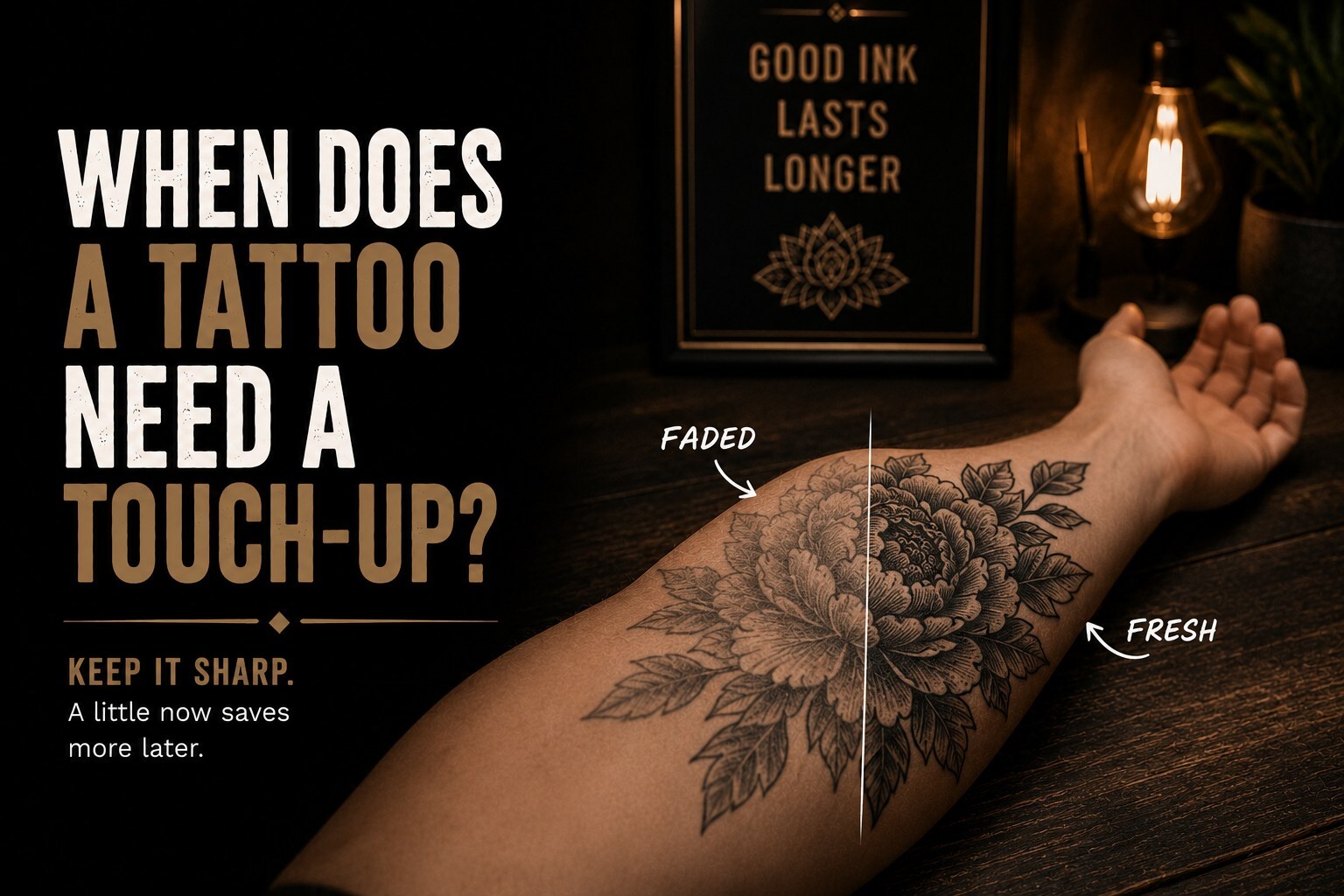
Tattoos change. That’s completely normal.
A tattoo that has been on your skin for five, ten or twenty years isn’t going to look exactly as it did the day it was finished. Even a brand-new tattoo can look surprisingly different once it has gone through the healing process.
That doesn’t automatically mean it needs fixing.
A touch-up can be useful when a small area hasn’t healed as strongly as the rest, when colour has dropped out or when an older tattoo could genuinely benefit from being refreshed. But tattoos don’t need routine maintenance just because they’ve softened a little with age.
If you’re looking at yours wondering whether it needs another pass, the first question is actually quite simple: is there something about it that bothers you?
If the answer is no, you may not need to do anything at all.
What Is a Tattoo Touch-Up?
A touch-up is usually a relatively small amount of additional tattooing used to improve an area of an existing tattoo.
That might mean going back over a small patch where the ink healed lighter than expected, strengthening part of a line, adding a little more colour or evening out an area that hasn’t settled quite like the rest.
It doesn’t necessarily mean the original tattoo was badly done.
Skin isn’t completely predictable. Two areas of the same tattoo can be applied during the same appointment, cared for in exactly the same way and still heal slightly differently.
Placement can make a difference too. Areas such as hands, fingers and feet can be particularly awkward because of how they heal and how much use they get in everyday life.
Sometimes a little extra work once everything has settled is simply the sensible way to finish the job.
Don’t Judge a New Tattoo Until It Has Fully Healed
This is probably the most important thing to know if your tattoo is relatively new.
Give it time.
Tattoos can look strange while they’re healing. They can appear dull, cloudy, shiny or patchy at different stages. They may flake and itch. Some areas can temporarily look lighter than others.
None of that gives you a particularly reliable picture of what the finished tattoo will look like.
At The Inkpot, we generally wouldn’t assess whether a tattoo needs touching up until it has fully healed, which means waiting at least around a month.
Trying to decide too early can leave you worrying about something that would have settled perfectly well on its own.
Let the skin finish healing first. Then look at the tattoo properly.
When Might a New Tattoo Benefit From a Touch-Up?
Once everything has healed, you may notice a small area that looks lighter than the rest.
Perhaps a little patch of shading hasn’t retained quite as strongly. Maybe part of a colour looks less saturated than the surrounding area. Occasionally a small section of linework may need another pass.
Those are the sorts of things a touch-up can be useful for.
Colour can sometimes need another pass too. In our experience at The Inkpot, yellow in particular can occasionally need a little extra attention once healed.
The important thing is to judge the healed tattoo rather than trying to predict the result halfway through the healing process.
If you’re unsure, send your artist a clear photograph or pop in and let them have a look.
Needing a Touch-Up Doesn’t Automatically Mean Something Went Wrong
There’s a tendency to think that a tattoo needing a touch-up must mean either the artist did something wrong or the client didn’t look after it properly.
It really isn’t that simple.
Tattooing involves putting pigment into living skin, and living skin varies.
Sometimes an area simply heals lighter than expected despite everything being done properly.
This is particularly relevant with delicate work. At The Inkpot, we would rather err slightly on the side of too light with fine line tattooing and add a little more once everything has healed than put too much into the skin initially.
You can always add a little more ink.
Taking it back out is considerably harder.
That’s why a small touch-up after healing can sometimes be part of a careful approach rather than evidence that something has failed.
What About Older Tattoos?
Older tattoos are slightly different.
All tattoos change to some degree over time. Lines can soften, colours can become less vibrant and the tattoo generally stops having that very crisp appearance it had when it was fresh.
That’s normal.
It also doesn’t mean you have to keep refreshing it every few years.
If you still like the way your tattoo looks, leave it alone.
There’s no rule saying black has to remain as dark as it was on day one or that every colour needs to look freshly applied forever.
Sometimes an older tattoo looks perfectly good with a little softness to it.
The useful question is:
Do you actually want something changed, or have you just noticed that the tattoo looks older because you’re examining it closely?
Those are two very different things.
When an Older Tattoo Might Benefit From More Work
If an older tattoo has become noticeably lighter and you miss the contrast it originally had, refreshing parts of it may help.
Colour can sometimes be strengthened. Areas of shading may be refreshed. Some lines may be suitable for another pass.
But this depends entirely on what has happened to the original tattoo.
If the existing ink has spread and tiny details have merged together, simply putting more ink over the top won’t magically separate those details again.
Likewise, if an old tattoo has changed significantly, trying to make it look exactly as it did when it was new may not be realistic.
Sometimes there’s room to improve it.
Sometimes the better option is to adapt it.
And sometimes the best advice is to leave it alone.
A good artist should be willing to tell you which situation you’re dealing with.
A Touch-Up and a Rework Aren’t Quite the Same Thing
The words are sometimes used interchangeably, but there’s a useful distinction.
A touch-up is generally about making relatively small improvements to the tattoo that’s already there.
A rework can be more involved.
For example, an older tattoo may have lost enough definition that simply retracing the original design wouldn’t achieve very much. Instead, an artist might need to change parts of the design, introduce stronger contrast, simplify areas or add new elements around what’s already there.
At that point, you’re doing more than touching up a few faded areas. You’re working with the tattoo as it exists now and finding the best way forward.
This is why it’s worth letting an artist actually see the tattoo before deciding what it needs.
Can a Touch-Up Fix Blurred Lines?
Not always.
This is an important limitation because adding more ink isn’t automatically the solution to every ageing tattoo.
If a line has simply healed a little lighter than intended, another pass may help.
If lines have spread into one another and fine details are no longer distinct, adding more pigment can sometimes make the area even busier rather than sharpening it.
An artist may be able to improve the surrounding contrast or adjust the design so the area reads more clearly, but there are limits to what can be restored.
That’s also one of the reasons we’re cautious about squeezing too much detail into very small tattoos in the first place.
Giving a design enough room at the beginning gives those details more space to settle and age.
Does Fading Mean You Need a Touch-Up?
No.
Fading is only a problem if you’re unhappy with it.
Sun exposure can contribute to tattoos losing some of their vibrancy over time, which is one reason looking after your skin and protecting healed tattoos from excessive sun exposure is worthwhile.
Placement can influence things too, particularly on areas such as hands, fingers and feet where tattoos can sometimes be more difficult to heal and retain consistently.
But there isn’t a timetable that says a tattoo should be refreshed after a certain number of years.
Some people have decades-old tattoos they wouldn’t change at all.
Others decide they’d like to bring some contrast or colour back.
Both are completely reasonable.
What If You Think Aftercare Affected It?
Aftercare can influence how a fresh tattoo heals, but try not to immediately blame yourself if a small area hasn’t retained perfectly.
Picking or scratching at healing skin, soaking a fresh tattoo or ignoring the aftercare advice you were given certainly isn’t going to help.
But somebody can follow their aftercare properly and still end up with a small area that heals differently from the rest.
Skin isn’t a printer.
If something needs another pass, the useful question isn’t necessarily whose fault it was.
It’s whether the tattoo has fully healed and whether touching that area up would actually improve it.
How to Decide Whether Yours Needs a Touch-Up
Start by looking at the tattoo normally.
Not with your nose six inches away from it under the brightest light you can find.
Just look at it.
Does anything genuinely bother you?
If there’s a clearly lighter patch, missing bit of colour or another area you keep noticing, it’s worth asking your artist about it.
If you’re scrutinising every millimetre trying to find something imperfect, you may simply be looking much more closely than anybody ever normally sees the tattoo.
Remember that tattoos are handmade in living skin. They aren’t digital images, and they aren’t going to remain frozen in exactly the same state forever.
That’s part of tattooing.
Ask Before Adding More Ink
If you’re unsure, let an artist look at it.
They should be able to tell you whether another pass is likely to improve the tattoo, whether it needs a more substantial rework or whether they genuinely think you’re better off leaving it alone.
And remember that a touch-up is still tattooing.
The skin has to be tattooed again and it has to heal again, so there’s no point doing it simply because you feel as though tattoos are supposed to be periodically refreshed.
More ink isn’t automatically better.
Final Thoughts
A tattoo doesn’t need a touch-up simply because it has changed.
If it’s new, let it heal completely before judging it. If a small area has healed lighter or lost some colour, another pass may be all it needs.
If it’s older, some softening and fading is part of having a tattoo on living skin. You can choose to refresh it if you want to, but you don’t have to.
And if details have blurred or the tattoo has changed substantially, it may need something more considered than a straightforward touch-up.
Most importantly, if you’re happy with your tattoo, you don’t need to go looking for something to fix.
At The Inkpot Studio in Ross-on-Wye, we’re always happy to have a look and give you an honest opinion. If we think a touch-up would improve it, we’ll explain why. If we think it’s better left alone, we’ll tell you that too.
If you’re unsure, just ask. Sometimes another pass is useful. Sometimes your tattoo is simply doing what tattoos do: settling in and becoming part of you.
Got a tattoo idea in mind? Book your free consultation with The Inkpot and we???ll help you turn it into something you???ll love.