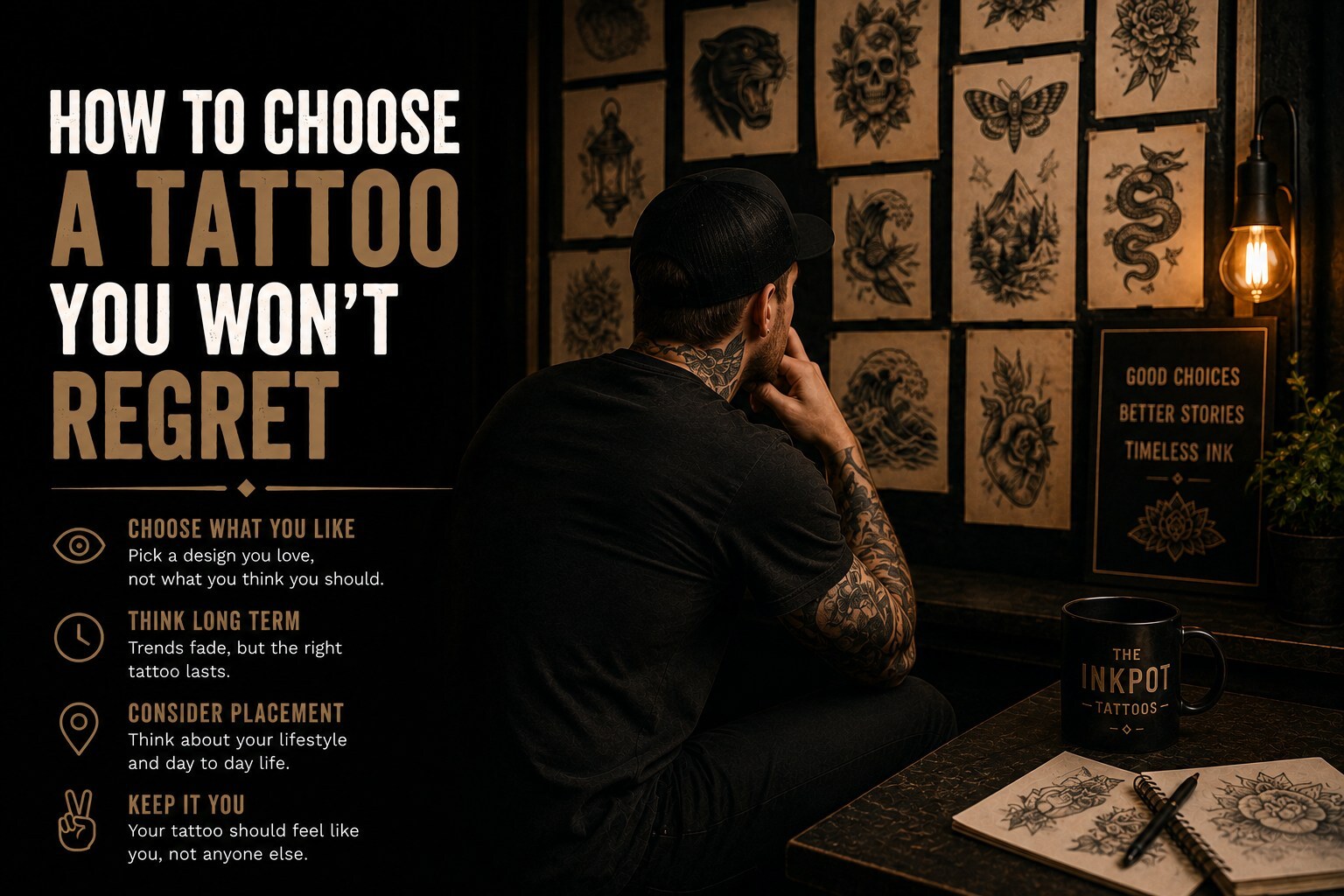
Choosing a tattoo you won’t regret sounds simple enough. Just pick something you really love, right?
The trouble is that nobody can tell you what you’ll love in ten, twenty or forty years. Your taste will change. Your life will change. You’ll change.
That doesn’t mean you need to find some mythical “timeless” tattoo that future you is guaranteed to adore. It just means making a decision you’re comfortable standing behind, even if your tastes are different one day.
And despite what you might have heard, that doesn’t mean every tattoo needs a deep meaning either.
Sometimes a tattoo represents somebody you love. Sometimes it marks an important part of your life. And sometimes you just really like frogs.
All three are perfectly good reasons to get tattooed.
Choose Something Because You Like It
This sounds painfully obvious, but it’s probably the best place to start.
Try to separate what you genuinely like from what you feel you should like.
Social media makes this harder than it used to be. If you see the same style of tattoo hundreds of times, it can start to feel like the obvious thing to get. That doesn’t automatically make it a bad choice. Trends become popular because people like them.
The useful question is whether you’d still want the tattoo if you hadn’t seen everybody else getting one.
The same applies to other people’s opinions. Friends, partners and family will often have plenty of thoughts about what you should get, where you should put it and how big it should be.
Listen if their opinion matters to you, but remember whose body it’s going on.
You’re the one who has to live with it.
Your Tattoo Doesn’t Need a Deep Meaning
There can be a strange amount of pressure around tattoos having to “mean something”.
They really don’t.
A meaningful tattoo can be incredibly special, but liking the artwork is also a perfectly good reason to have something tattooed.
In fact, trying too hard to manufacture meaning can sometimes make choosing a design more difficult than it needs to be.
If you love a particular animal, flower, character, painting, pattern or completely ridiculous little creature, you don’t need to write an essay explaining why.
You can simply like it.
Meaning can change over time anyway. A tattoo you originally chose purely because you liked the design might eventually remind you of the period of your life when you got it, the person you were at the time or the experience of getting tattooed.
Not everything needs to start with a story.
Don’t Try to Choose for Your Future Self
One of the easiest ways to overthink a tattoo is trying to imagine whether you’ll still choose exactly the same thing when you’re 50, 60 or 70.
You probably won’t.
But that isn’t necessarily the same thing as regret.
Most of us wouldn’t choose the same clothes, haircut, furniture or music we loved twenty years ago either. That doesn’t mean those choices were mistakes.
A tattoo can become part of the story of who you were as well as who you are now.
A more useful question might be:
“If my tastes change one day, am I still comfortable with this being part of my story?”
That takes away the impossible task of predicting what future you will like.
If You’re Unsure, Give Yourself More Time
There’s a difference between normal pre-tattoo nerves and genuinely not being sure about the tattoo itself.
If you love the design but feel nervous because it’s your first tattoo, that’s completely normal.
If you keep changing the design, questioning whether you actually want it or trying to convince yourself that you’ll grow to like something, that might be worth listening to.
You don’t have to make the decision today.
Save the idea. Come back to it in a couple of weeks. Look at other versions. Talk it through with an artist.
If you still love it, brilliant.
If you don’t, you’ve discovered that before it became permanent.
There’s no prize for making the decision quickly.
Choose the Right Artist, Not Just the Right Design
You can spend months choosing a tattoo and still be disappointed if you choose the wrong person to create it.
Look through an artist’s portfolio properly.
If you want black and grey realism, look at their black and grey realism. If you want bold colour, look at how they use colour. If you want something delicate, look at examples of delicate tattoos they’ve actually produced.
A talented tattoo artist isn’t automatically the right artist for every tattoo.
Ideally, you should find someone whose existing work already has something about it that you love.
That way you’re not asking an artist to imitate somebody else’s style. You’re giving your idea to somebody whose natural way of working already suits it.
Use References as Inspiration, Not a Shopping Catalogue
Finding another tattoo online and thinking, “I want exactly that,” is understandable.
But somebody else’s finished tattoo is usually much more useful as a reference than something to copy exactly.
Ask yourself what you actually like about it.
Is it the subject? The colours? The composition? The shading? The amount of detail? The way it sits on the body?
You might discover that you don’t actually want that exact tattoo at all. You want the feeling or style of it.
That gives your artist room to create something that belongs to you rather than producing a duplicate of somebody else’s work.
You don’t need hundreds of references either. If you already have a reasonably clear idea, one or two strong examples can sometimes explain what you want better than fifty slightly different Pinterest screenshots.
Don’t Make It Tiny Just Because You’re Nervous
This comes up surprisingly often with first tattoos.
Someone loves a design but feels nervous about committing to it, so the instinct is to make it as small as possible.
Small tattoos can be lovely. The problem is trying to squeeze a design containing lots of detail into a space that simply doesn’t have enough room for it.
Tattoo ink doesn’t stay frozen exactly where it was placed forever. Tattoos settle and change as they age, and tiny details need enough space around them to remain readable.
That doesn’t mean your artist should talk you into something enormous.
It means the size and the amount of detail need to make sense together.
If your artist recommends making something slightly larger, ask them why. A good artist should be able to explain what they’re trying to protect rather than simply telling you that you have to do it their way.
Think Properly About Placement
Placement can be just as important as the design itself.
Think about how visible you want the tattoo to be, whether you need to cover it for work, how it fits with tattoos you might want in the future and whether the shape of the design actually suits that part of your body.
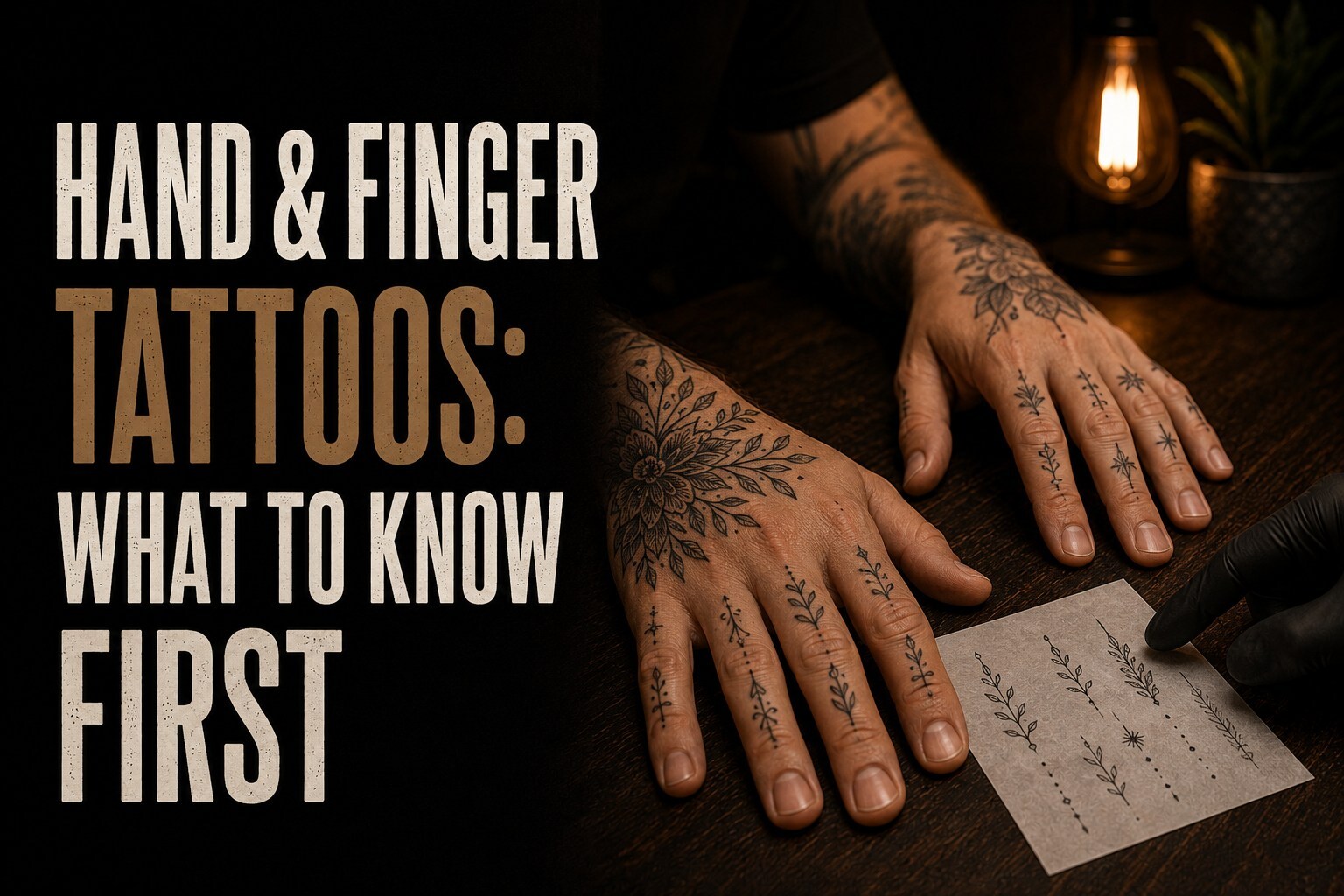
Some placements also tend to be harder on tattoos than others. Hands and fingers, for example, live a very different life from an upper arm.
None of that means there’s one “correct” place for a tattoo.
It just means placement deserves a little more thought than pointing at an empty patch of skin.
Your artist can help here too. Sometimes moving a design slightly or changing its orientation makes a surprisingly big difference to how naturally it sits on the body.
Speak Up Before the Tattoo Starts
This is a big one.
If you don’t like something, say so before the tattoo starts.
If the stencil feels too high, too low or slightly off-centre, ask to move it.
If you thought the tattoo would be larger, say so.
If you’re unsure about part of the design, talk about it.
You are not being difficult.
Your artist would much rather spend another few minutes getting the stencil or design right than discover afterwards that you stayed quiet because you didn’t want to cause a fuss.
At the same time, listen to their advice. If they’re recommending a change because a detail is too small, the placement is awkward or something isn’t likely to work well as a tattoo, ask them to explain why.
The best result usually sits somewhere between your idea and their experience.
Be Careful With Highly Visible Placements
There’s nothing wrong with hand, neck or other highly visible tattoos.
But if you’re unsure, they deserve a little extra thought simply because you have fewer options for covering them.
This is particularly worth considering for a first tattoo.
You might be completely comfortable with something visible every day, in which case great. But if part of you is already worried about work, family or simply whether you want your tattoo on show all the time, there’s no harm in choosing somewhere less exposed first.
You can always get more tattoos later.
You don’t have to make your first one the biggest commitment possible.
Don’t Choose on Price Alone
Tattoos cost money. Budgets are real, and there’s nothing wrong with having one.
But price probably shouldn’t be the deciding factor between two artists whose work is completely different.
If one artist costs less but the other consistently produces exactly the kind of work you want, that difference is worth thinking about.
Likewise, the most expensive artist isn’t automatically the best artist for you.
Look at the work. Look at how they communicate. Make sure you feel listened to. Make sure the studio is properly licensed and that you feel comfortable there.
You’re choosing the person who will permanently put the artwork into your skin, not simply comparing two prices for the same product.
Accept That No Tattoo Comes With a Regret Guarantee
This might be the most important part.
Nobody can promise that you’ll feel exactly the same about a tattoo for the rest of your life.
And trying to guarantee that can make choosing one almost impossible.
Your tastes may change. Your body will change. The things that matter to you will change.
What you can do is make a thoughtful decision now.
Choose something because you want it. Find an artist whose work you trust. Give the design enough room to work. Think about the placement. Ask questions. And if you’re genuinely unsure, give yourself more time.
That’s about as much certainty as anybody can reasonably have before doing something permanent.
Final Thoughts
Choosing a tattoo you won’t regret isn’t really about finding the one design you’re guaranteed to love forever.
It’s about making a decision that feels genuinely yours.
You might look at the tattoo twenty years from now and realise you’d choose something completely different today.
That doesn’t automatically make the original choice a mistake.
Sometimes tattoos grow with us. Sometimes they remind us of who we used to be. And sometimes the frog wearing a cowboy hat is still just a really good frog wearing a cowboy hat.
If you’ve got an idea but you’re still trying to work out the design, size or placement, you don’t need to figure it all out alone. At The Inkpot Studio in Ross-on-Wye, our consultations are free and currently include a coffee, so you can sit down, talk it through and ask questions without feeling pressured to book.
If you’d like to talk an idea through, we’re always happy to help.
Got a tattoo idea in mind? Book your free consultation with The Inkpot and we’ll help you turn it into something you’ll love.