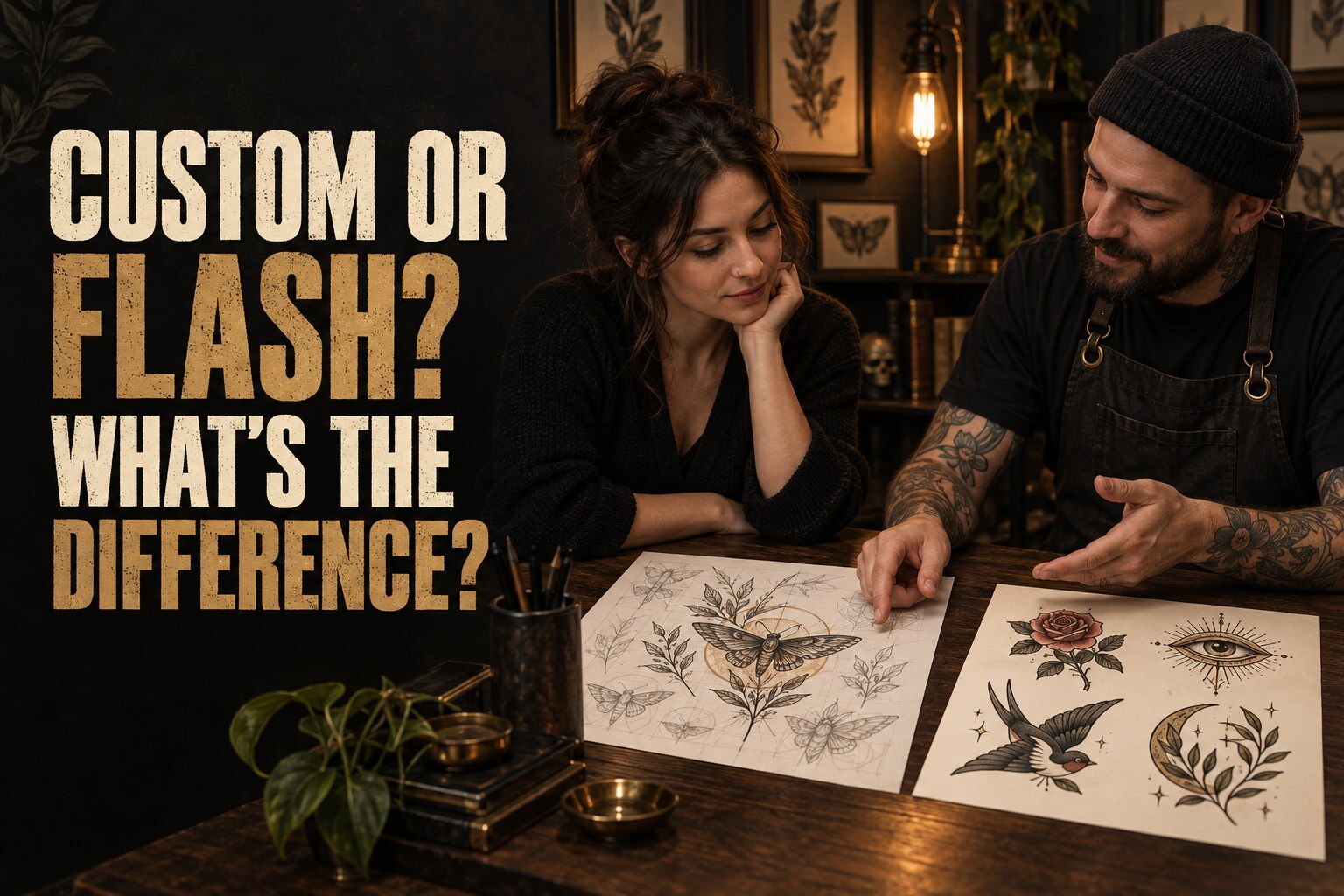
Custom or flash?
It sounds like a choice between “deeply meaningful work of art” and “something picked from a sheet in five minutes”. In reality, both routes can produce a brilliant tattoo, and both can be personal.
The main difference is simply where the design process begins. A custom tattoo begins with your brief. A flash tattoo begins with artwork the artist has already created.
Here is what that means in practice — including the bits people often assume incorrectly.
The short answer: custom starts with an idea, flash starts with a design
With a custom tattoo, you bring an idea, references, a subject or perhaps just a general mood. The artist develops a design for you, taking account of the size, placement, style and how the piece needs to work on the body.
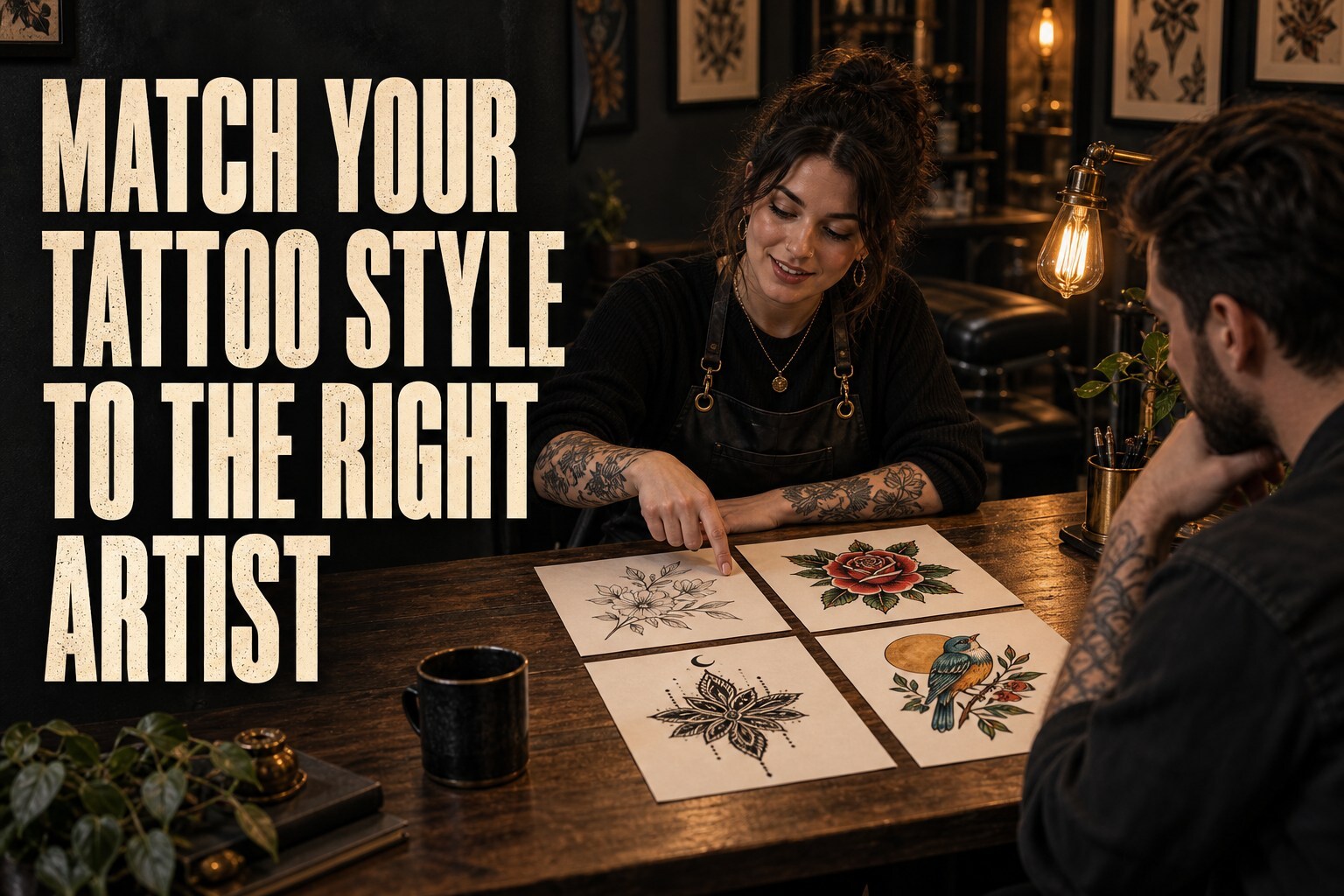
With a flash tattoo, the artist has already drawn the design and made it available to be tattooed. You choose a piece you genuinely like, then discuss whether it is available, what size will work and where it could sit.
Neither approach is the “proper” one. The better option is the one that fits how specific your idea is and how much of the design has already clicked into place.
What is a custom tattoo?
A custom tattoo is developed around an individual client and project. It might begin with a story, a particular subject, a collection of references, an existing tattoo it needs to work beside or an awkward bit of anatomy that needs a clever composition.
“Custom” does not have to mean enormous, complicated or solemn. A tiny symbol can be custom. So can a playful frog, an abstract shape or a flower chosen purely because you like flowers.
It also does not mean an artist draws in a vacuum. References are useful because they show the mood, linework, level of detail and composition you enjoy. The artist then uses that information to create something original rather than tracing another tattoo.
Our guide to why we do not copy other artists’ tattoos exactly explains how inspiration becomes a design that suits your body and belongs to your project.
What is a flash tattoo?
Flash is artwork drawn by a tattoo artist before a particular client chooses it. Traditionally, flash sheets displayed an artist’s designs and advertised the kind of work available in the studio. The Smithsonian National Air and Space Museum describes flash as designs created by tattooists, displayed on paper or board and replicated as tattoos.
Modern flash can be shown on a studio wall, in a book, on a website or through an artist’s social feed. It might be a neat page of tiny motifs, a detailed one-off drawing, a themed collection or artwork made for a flash day.
The design is already there, but that does not mean every practical decision has been made. Size, placement and sometimes colour may still need discussion. A responsible artist will check that the piece works on the part of the body you have chosen rather than treating skin like a sheet of printer paper.
Is flash always repeated?
No. This is one of the most useful questions to ask before booking.
Some flash is repeatable, which means the artist is happy to tattoo the design more than once. Some is one-off, which means it is no longer available after somebody claims it. An artist may also repeat a design only with agreed changes or limit it by placement.
There is no universal rule. The person who created the flash decides how it is offered, so check the policy rather than assuming.
If you find flash drawn by an artist elsewhere, a screenshot does not make it free for another studio to reproduce. If you want that exact piece, book with the artist who created it or ask whether they offer permission or a tattoo ticket. Otherwise, use it as inspiration for a separate original design.
Can you change a flash design?
Sometimes — but not always.
An artist may be happy to adjust the size, use a different approved colour palette, remove a small optional element or position the design differently. Another artist may offer the piece exactly as drawn.
If you want to change the composition, combine several designs or redraw the style, you may no longer be choosing flash at all. You are asking for a custom piece inspired by it.
That is not a problem. It just needs an honest conversation so the artist can explain what is flexible, what is part of the original design and how much new drawing is involved.
Does custom mean nobody else will have the same tattoo?
A custom tattoo is usually intended for the client it was designed for, but “custom” is not a magic legal or practical guarantee that no similar motif will ever appear again.
Flowers, moths, snakes, skulls, lettering and ornamental shapes are shared parts of tattoo language. An artist may return to the same subject while creating a different composition for each person.
At The Inkpot, we do not directly repeat another client’s custom tattoo or copy work created by another artist. If exclusivity or future use of a design matters to you, ask about it during the consultation rather than relying on the label alone.
Is flash less personal?
Only if it feels less personal to you.
A tattoo can matter because it was designed around your story. It can also matter because you saw a drawing and immediately thought, “That one.” The meaning comes from your relationship with the tattoo, not from how many preliminary sketches were involved.
Flash can be especially enjoyable if you like the artist’s work and want to give them room to tattoo something they were excited enough to draw for themselves. Sometimes the instant connection is the whole point.
How does the process differ?
For a custom tattoo
- You share the idea, placement, approximate size and useful references.
- The artist checks whether the project fits their style and experience.
- You discuss what will work on the body and agree the overall direction.
- The artist develops the design according to their usual process.
- Reasonable adjustments are discussed within the studio’s design policy.
- The final size and stencil placement are confirmed before tattooing begins.
Ask when you can expect to see the design. Some artists share work in advance; others finalise it close to the appointment and allow time for sensible adjustments on the day. Neither approach should be a surprise after you have paid a deposit.
For a flash tattoo
- You choose a design from the artist who created it.
- You check whether it is repeatable, one-off and still available.
- You agree any permitted colour, size or placement options.
- The artist confirms the price and books the appropriate appointment.
- The stencil placement is checked with you before tattooing begins.
Flash can shorten the drawing stage, but it does not automatically mean a walk-in or same-day appointment. The artist still needs enough diary time for the design, placement and safe setup.
Which costs more: custom or flash?
There is no reliable “custom costs more” rule.
Tattoo prices are normally shaped by the size, placement, detail, colour, complexity and time required. A small flash design may cost less than a large custom piece, but a detailed one-off flash tattoo can take a substantial session too.
At The Inkpot, every tattoo is quoted individually. Our current tattoo pricing guide lists the session options and £50 minimum charge, but your actual quote depends on the work.
We usually ask for a 20% deposit once a date is confirmed. It forms part of the final price rather than being added on top, and it applies to the booked appointment rather than acting as a badge for one design type. You can read the full explanation in why tattoo deposits matter.
When might custom suit you?
Custom may be the better route if:
- you have a specific idea or personal story;
- the tattoo needs to fit around existing work;
- the placement requires a design shaped closely to your body;
- you want several references combined into one original composition;
- you like an artist’s style but none of their available flash is quite right.
When might flash suit you?
Flash may suit you if:
- you have found a finished design you already love;
- you enjoy the artist’s visual style and want that drawing as it is;
- you prefer choosing from clear options rather than starting with a blank page;
- you are comfortable with the design being repeatable, or you have confirmed it is one-off;
- you want a simpler design stage without assuming the appointment itself will be immediate.
What stays the same whichever you choose?
Custom and flash tattoos need the same care when it comes to the artist, studio and appointment.
Look at the artist’s own portfolio and choose somebody whose work suits the design. In Herefordshire, both the person carrying out tattooing and the premises must be registered with the council. You should also expect clear hygiene practices, honest advice about size and placement, a chance to check the stencil, and aftercare instructions suited to the finished tattoo.
Custom does not excuse poor preparation, and flash does not mean “quick and casual”. It is still a permanent tattoo and deserves a properly considered appointment.
A quick custom-versus-flash checklist
- Do I already love an available design, or do I want something developed from my idea?
- If it is flash, is it repeatable or one-off?
- What changes, if any, will the artist allow?
- Does the artist’s portfolio fit the style?
- Will the design work at the size and placement I want?
- What is included in the quote and deposit?
- Do I feel informed rather than hurried?
Final thoughts
Custom tattoos and flash tattoos are not rivals. One begins with a conversation; the other begins with a drawing.
Choose custom when you want the design built around your brief. Choose flash when an artist has already drawn something that feels right. Then give either option the same sensible checks around placement, price, originality, safety and aftercare.
If you are still torn, bring the idea — or the flash piece you have your eye on — to a consultation. We can explain what is available, what can be adapted and whether a custom route would suit you better. No dramatic declaration of allegiance required.
Got a tattoo idea in mind? Book your free consultation with The Inkpot and we’ll help you turn it into something you’ll love.