
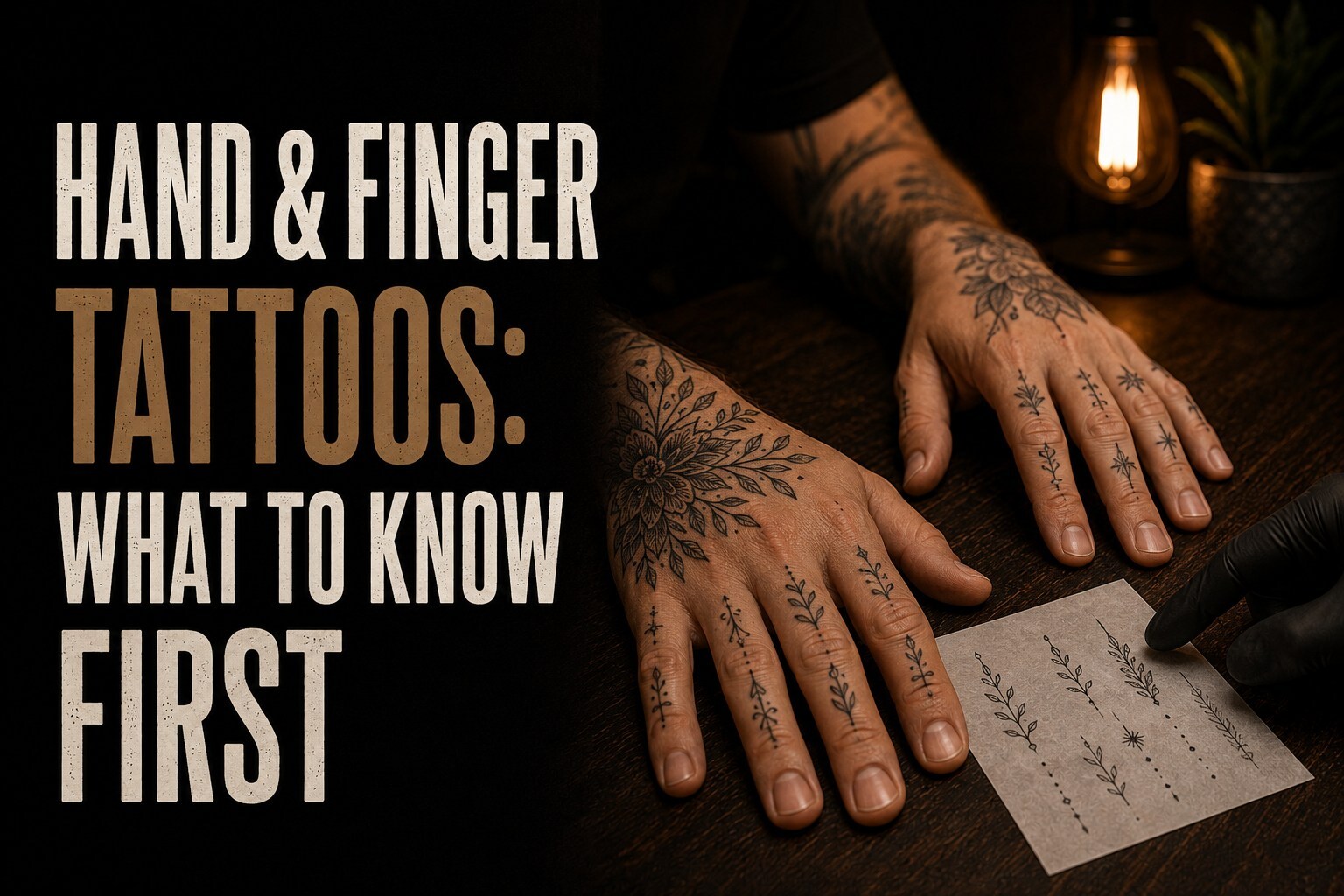
Hand and finger tattoos can look brilliant. They are bold, personal and almost impossible to ignore. They also come with a few more practical considerations than a tattoo tucked safely under a sleeve.
Your hands are constantly moving, being washed, brushing against things and seeing the sun. That does not mean you should avoid tattooing them. It simply means that the design, placement, timing and aftercare all deserve a little extra thought.
Here is the honest version of what to expect before you book.
Why do hand and finger tattoos behave differently?
Hands work hard. They flex, grip, rub against clothing and surfaces, meet soap and cleaning products, and are exposed to the weather far more often than most tattooed areas.
Even within the hand, placement makes a difference. The top of the hand, knuckles, sides of the fingers, undersides of the fingers and palm do not all hold ink in the same way. Areas that see more friction and movement can soften or fade sooner, and some placements are more likely to need a touch-up.
There are no honest guarantees about exactly how a hand tattoo will settle. Your skin, your work, your lifestyle, the design and the precise placement all play a part. A good artist will talk you through what is realistic for the area you have chosen.
Designing for a small, moving canvas
Hand and finger tattoos are compact, but that does not mean every small design will work well there.
Simple, clear and well-spaced designs usually have the best chance of staying readable as the tattoo ages. Very tiny details, tightly packed lines and miniature lettering can lose definition over time. Your artist may suggest making the design a little larger, opening up the spacing or simplifying one part of it.
Fine line is not automatically better than bold work, and bold work is not automatically a problem. What matters is choosing a line weight, level of detail and amount of negative space that suit both the design and the exact area of the hand.
In other words, a detailed design made for an upper arm cannot always be shrunk to two centimetres and expected to behave itself. Skin has other plans.
Ask to see healed examples of the artist’s hand and finger work, not only photographs taken immediately after the appointment. Fresh tattoos are lovely, but healed results tell you much more.
Think about visibility before the appointment
A hand tattoo is visible in a way that most placements are not. Long sleeves will not reliably cover it, and finger tattoos can still show beneath jewellery or gloves.
Workplace rules vary, so check your employer’s policy if that could affect you. It is also worth thinking about future roles, formal occasions and whether you are comfortable answering the occasional question from a curious stranger.
This is not a reason to talk yourself out of a tattoo you genuinely want. It is simply one of those decisions that feels much easier when you have considered the everyday reality first.
Do hand and finger tattoos hurt more?
Tattoo pain is personal. Hands and fingers include bony areas with relatively little cushioning, so many people find them sharp or intense. Other people cope with them perfectly well.
The encouraging part is that most hand and finger designs are smaller than a full sleeve piece, so the appointment may be shorter. Your artist can explain the likely session length and help you prepare without promising an entirely painless afternoon.
Healing can be more awkward
You still need your hands while they heal, which is the main complication. Washing up, typing, manual work, food preparation, the gym, childcare and wearing work gloves can all add rubbing, moisture or mess to the equation.
Tell your artist what you do for work and how you use your hands before the appointment. If your job involves heavy manual work, chemicals, repeated handwashing or tight protective gloves, it may be sensible to choose your appointment date around a quieter period.
Our guide to tattoo placements that can be harder to heal explains why lifestyle matters as much as location.
How should you look after a hand or finger tattoo?
Always follow the aftercare instructions your artist gives you. Dressings and products vary, so their advice should be specific to the tattoo and the way it has been covered.
A few principles are especially useful for hands:
- Wash your hands before touching the tattoo. Keep the area clean, but do not scrub it or repeatedly wash it for the sake of it.
- Avoid soaking. Baths, swimming pools and long sessions with your hands in water can interfere with healing.
- Be careful with friction. Tight gloves, rings, tools and repetitive movement may rub the area. Ask your artist how to manage anything you cannot avoid.
- Use only the aftercare products recommended to you. More product is not more healing, and an overly thick layer can leave the area soggy.
- Do not pick or peel. Flaking and itching can be a normal part of healing. Let the skin settle in its own time.
- Keep everyday surfaces in mind. Fresh tattoos and gardening, cleaning chemicals or a mystery substance under the kitchen sink are not ideal companions.
Some redness, tenderness, itching and light flaking can be normal early on. Increasing pain, spreading redness or swelling, strong heat, an unpleasant discharge, red streaks or feeling feverish are reasons to seek medical advice promptly. The NHS guidance on tattoos and cosmetic procedures explains when to contact a GP or seek urgent help. Your tattoo artist can help with routine aftercare questions, but they cannot diagnose an infection.
Will hand and finger tattoos fade?
All tattoos change gradually with time. Hand and finger tattoos often show that change sooner because of their exposure, movement and friction. The sides and undersides of fingers can be particularly unpredictable.
Fading does not necessarily mean anything went wrong. It may simply be part of choosing this placement. Wait until the tattoo is fully healed before judging the result or arranging more work, and ask your artist about their touch-up policy when you book.
If you are unsure whether a settled tattoo needs more ink, read our guide to when a tattoo needs a touch-up.
Protect it from the sun once it has healed
Hands see plenty of daylight, and ultraviolet light can contribute to fading. Once the tattoo is completely healed, protect it with shade or clothing where practical and use a broad-spectrum, water-resistant sunscreen of SPF 30 or higher. The American Academy of Dermatology’s tattooed-skin advice has more detail.
Do not put sunscreen on a fresh tattoo unless your artist or a healthcare professional has specifically told you to. During healing, follow your artist’s instructions instead.
What should you ask before booking?
A consultation is the best place to be honest about what you want and how you live. Useful questions include:
- Will this design remain readable at the size I want?
- Which part of the hand or finger is most suitable for it?
- Can I see healed examples of similar work?
- How might my job, hobbies or daily routine affect healing?
- What aftercare will this placement need?
- How likely is a touch-up, and what is the studio’s policy?
If an artist recommends adjusting the design or placement, it is not because they are trying to spoil the fun. They want the tattoo to look good after it has left the studio too.
Are hand and finger tattoos worth it?
For the right person, absolutely. They can be expressive, elegant, playful or properly striking. The key is going in with realistic expectations: they are highly visible, healing needs planning, and the finished tattoo may require more maintenance than work in a protected area.
Bring your idea, tell us how you use your hands, and let us help you choose a design and placement that make sense. A little planning now can save a lot of frustration later.
Got a tattoo idea in mind? Book your free consultation with The Inkpot and we’ll help you turn it into something you’ll love.